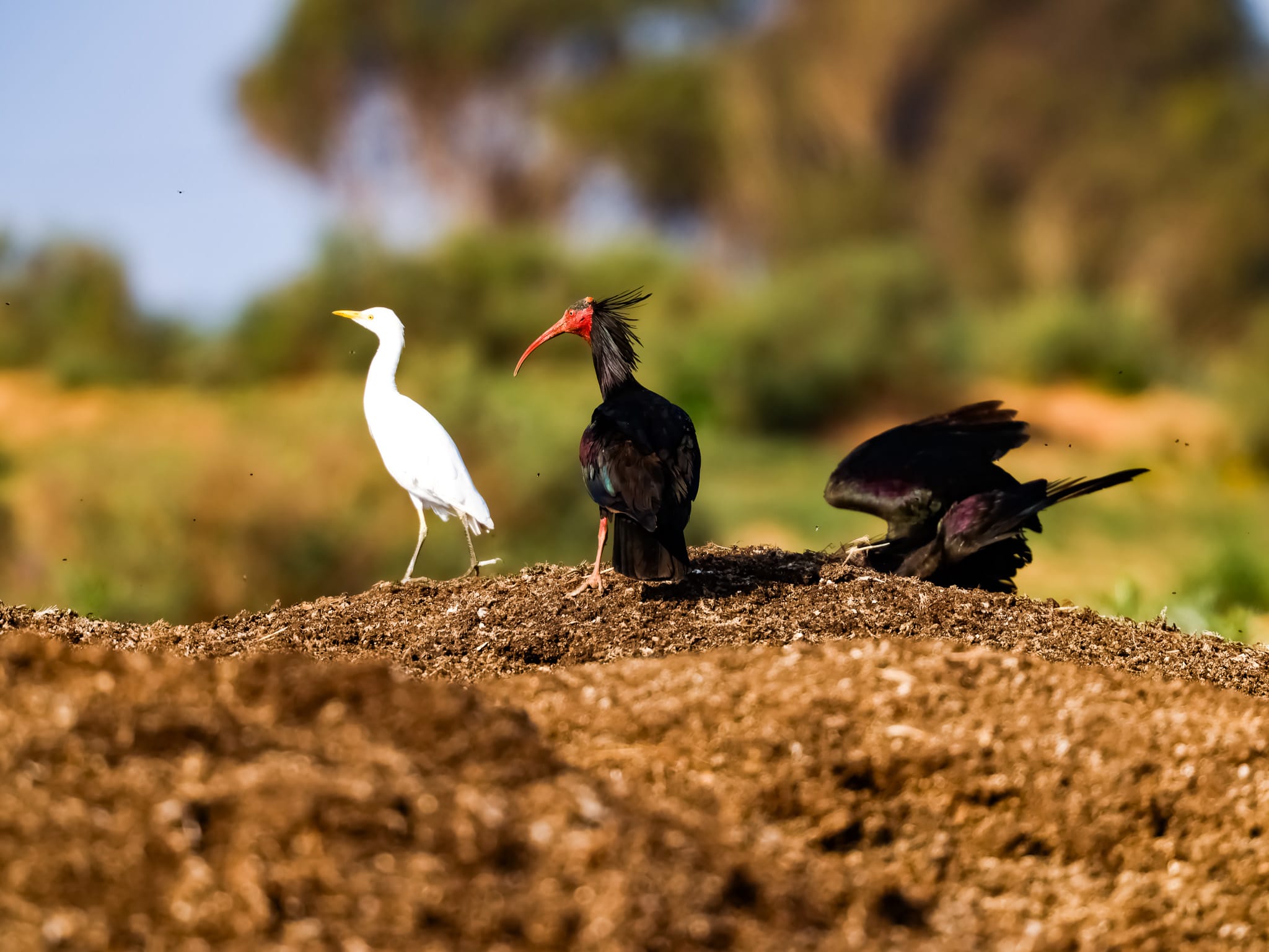
South of Agadir, along Morocco’s Atlantic coastline, lives a bird unlike almost any other: the Northern Bald Ibis. With its featherless red head, long curved bill and dark plumage shimmering with metallic hues, it has a truly distinctive appearance.
But there is much more to this bird than its striking appearance. Its story is also one of a species that has suffered a dramatic decline, before finding a vital stronghold for its survival in south-western Morocco.
Discover the Northern Bald Ibis and learn why certain landscapes, human activities and habitat conservation efforts are essential to protecting biodiversity.
How to Identify the Northern Bald Ibis?
The Northern Bald Ibis (Geronticus eremita) is a large bird belonging to the ibis family. Its distinctive appearance makes it easy to recognise among the many bird species found in the Souss-Massa region.
ts head and upper neck are featherless, revealing distinctive red skin. Its long, curved bill allows it to probe the ground for food. Its plumage is mainly black, with iridescent green or purple hues that shimmer in the light.
The longer feathers at the back of its neck also give it a distinctive silhouette.
In flight, its elongated silhouette and broad wings make it easier to recognise with a little practice. As these birds often move in groups, it can also be fascinating to observe how they interact with one another rather than focusing solely on identifying individual birds.
Where Does the Northern Bald Ibis Live in Morocco?
South-western Morocco plays a major role in the conservation of the wild Northern Bald Ibis. Its breeding populations are concentrated mainly in the Souss-Massa region and along the Tamri coastline, north of Agadir.
Unlike many bird species that mainly inhabit wetlands, the Northern Bald Ibis favours open, relatively dry environments. It forages in coastal steppes, sparsely vegetated areas, grasslands and some agricultural fields.
For nesting, it uses cliffs and rocky outcrops that provide suitable sites for breeding. Its feeding grounds also need to remain accessible and close to its roosting and nesting sites.
This close relationship between cliffs, open landscapes and feeding grounds highlights the importance of protecting entire natural habitats rather than focusing on a single isolated site.
What Does the Northern Bald Ibis Eat?
The Northern Bald Ibis’s long, curved bill is more than just a distinctive feature: it is an essential tool for finding food.
The bird probes the ground in search of small prey. Its diet includes insects, larvae, worms and other small animals. Depending on what is available locally, it may also feed on small vertebrates, including lizards.
Its diet depends heavily on local environmental conditions. The availability of prey, the structure of the vegetation and the condition of the soil all influence its feeding opportunities.
This is why protecting open areas rich in small wildlife is just as important as safeguarding the cliffs where the species breeds.
How Does the Northern Bald Ibis Live and Breed?
The Northern Bald Ibis is a sociable bird that often feeds and travels in groups. Individuals may head together to their feeding grounds before spreading out across the area to search for prey.
Breeding takes place in colonies on rocky cliffs. Pairs build their nests in suitable locations, where the eggs are laid and the chicks are raised.
In Morocco, monitoring the colonies in Souss-Massa and Tamri allows conservation teams to assess breeding success and gain a better understanding of the species’ needs.
Breeding success can vary from one year to the next. Weather conditions, food availability and disturbances at nesting sites can all play a role.
Why Is the Northern Bald Ibis Endangered?
The Northern Bald Ibis has experienced a significant historical decline. The loss and degradation of its habitats, human disturbance and various pressures on breeding sites have all contributed to the decline of its populations.
The species is currently classified as Endangered on the IUCN Red List, according to the reference assessment published in 2018.
This classification highlights that the species remains under threat, even though conservation efforts have led to a significant recovery of the Moroccan population from its historically low levels at the end of the 20th century.
Conservation is not just about preventing the birds from disappearing. It also means protecting the areas where they feed, rest and breed, while minimising disturbance around their breeding colonies.
Morocco’s Vital Role in Northern Bald Ibis Conservation
The Souss-Massa region holds a special place in the recent history of the Northern Bald Ibis. The establishment of helped protect important habitats for the species.
Scientific monitoring of populations, surveillance of nesting sites and collaboration between Moroccan authorities, conservation organisations and local teams all contribute to ongoing protection efforts.
Research carried out by GREPOM/BirdLife Morocco and its conservation programme partners helps monitor breeding populations and the number of chicks that successfully fledge.
These efforts show that protecting a species depends on several complementary factors: scientific research, regular monitoring, habitat conservation and the reduction of human disturbance.
Can You See the Northern Bald Ibis in the Souss-Massa Region?
The Souss-Massa region offers opportunities to observe the Northern Bald Ibis, but sightings can never be guaranteed on an excursion. These birds move according to their needs, and sensitive areas must always be protected.
To observe wildlife responsibly, it is best to take your time, keep a respectful distance and use binoculars rather than trying to get closer to the animals.
It is also important to stick to authorised areas and follow the guidance of people who know the region well. Nesting sites should never be approached just to get a photograph.
Responsible wildlife watching allows visitors to discover the species without disturbing it. It also reminds us that a successful nature experience is not measured solely by the number of animals spotted, but by the quality of the experience and the respect shown for the natural environment.
A Bird That Tells the Story of Souss-Massa
The Northern Bald Ibis is much more than an iconic bird of Southern Morocco. It reflects the region’s rich ecological heritage, but also the delicate balance of its natural ecosystems.
Its survival depends on landscapes that provide suitable places to feed, rest and breed without excessive disturbance. Protecting the Northern Bald Ibis therefore means safeguarding much more than a single species: it also means preserving the conditions that allow countless other forms of life to thrive.
For nature-loving travellers, exploring the Souss-Massa region with a mindful approach offers a deeper understanding of its biodiversity and the importance of protecting it.
Discover More: Explore our Souss-Massa National Park excursion and discover the region’s remarkable wildlife.